
A motivation letter often called a personal statement or statement of purpose, is one of the most important components of a scholarship application. It is your chance to speak directly to the selection committee and explain who you are beyond grades and certificates. A strong motivation letter can set you apart from hundreds of equally qualified applicants and significantly improve your chances of success.
Many applicants struggle with questions like: What should I include? How personal should it be? How do I structure it? Here we will answer those questions and walk you through the process of writing a clear, convincing, and original motivation letter that works for any scholarship, not just a specific program.
Why Is a Motivation Letter So Important?
The motivation letter allows the scholarship committee to understand your background, your ambitions, and your reasons for applying. While your transcripts show what you have achieved, the motivation letter explains why those achievements matter and how they connect to your future goals.
Through this document, you demonstrate:
- Your academic and professional direction
- Your motivation for choosing a particular field
- Your alignment with the values and objectives of the scholarship
- The impact you hope to create after completing your studies
Think of the motivation letter as your personal narrative. It represents your journey, your decisions, and your vision for the future. When written well, it can advocate for you more effectively than an interview.
One important rule: avoid copying or adapting someone else’s motivation letter. Every applicant has a unique background and story. A letter written in your own words, shaped around your experiences and goals, will always be more authentic and memorable.
Key Principles Before You Start Writing
1. Research the Scholarship Thoroughly
Before writing, make sure you clearly understand the scholarship’s purpose, eligibility criteria, and expectations. Review the mission of the funding organization, the academic focus of the program, and the type of candidates they aim to support. This understanding will help you tailor your letter and show that your goals align with theirs.
2. Plan Before You Write
Do not start writing immediately. First, brainstorm answers to questions such as:
- Why am I interested in this field of study?
- What experiences shaped this interest?
- How will this scholarship help me achieve my long-term goals?
- How do I plan to give back to my community, industry, or society?
Clear thinking at this stage will make your writing focused and coherent.
3. Maintain a Formal and Professional Tone
A motivation letter is an official document. Use clear, formal language and avoid slang, overly emotional expressions, or casual phrases. Pay close attention to grammar, spelling, and punctuation. Small mistakes can create a negative impression.
4. Be Concise and Relevant
Most scholarships expect a motivation letter of around 500–700 words, unless stated otherwise. Stay within the required limit and focus only on relevant information. Quality matters far more than length. Avoid repetition, exaggeration, or unnecessary details.
5. Support Your Claims With Examples
Rather than making broad statements about your skills or interests, support them with concrete examples. Mention specific projects, research work, internships, or initiatives that demonstrate your motivation and competence. Always keep examples relevant to the scholarship and your field of study.
Recommended Structure of a Letter of Motivation
1. Header and Contact Information
At the top of the page, include:
- Your full name
- Address and postal code
- Email address and phone number
Optional details such as professional profiles may be included if relevant.
2. Introduction
Begin with a formal greeting and clearly state the purpose of your letter. Briefly explain why you are applying for the scholarship and what motivates you to pursue this program. Mention what attracted you to the field, institution, or country, and connect it to your long-term objectives.
The introduction should be direct, focused, and free of clichés.
3. Academic and Professional Background
In this section, describe your educational background and key achievements. Highlight coursework, research, or practical experiences that sparked or strengthened your interest in the field. If applicable, include relevant professional or volunteer experience.
4. Connecting Past Experiences to Your Chosen Path
Explain how your previous studies, projects, internships, or work experiences prepared you for this program. Show a logical progression in your journey and clarify how these experiences influenced your academic and career direction.
5. Your Value as a Candidate
Here, explain what you bring to the program. Discuss your skills, strengths, and achievements, and show how they can contribute to the academic environment or broader goals of the scholarship. Focus on impact, collaboration, and growth.
6. Why This Program or Institution?
Demonstrate that you have carefully chosen this program. Mention specific aspects such as curriculum structure, research opportunities, facilities, or faculty expertise that align with your interests. Explain how these resources will help you develop academically and professionally.
7. Future Goals
Clearly outline your short-term and long-term goals. Explain how the scholarship will serve as a stepping stone toward these objectives and how you plan to apply your knowledge and skills in the future—whether in industry, research, policy, or community development.
8. Conclusion
End with a confident and positive conclusion. Reaffirm your motivation, readiness, and commitment to making the most of the opportunity. Express appreciation for the committee’s time and consideration.
Common Mistakes to Avoid
- Being too vague: Avoid generic statements that could apply to any applicant.
- Focusing only on personal gain: Emphasize contribution and impact, not just self-development.
- Ignoring instructions: Always follow formatting, word count, and submission guidelines.
- Last-minute writing: Start early to allow time for revision and proofreading.
Motivation Letter Template
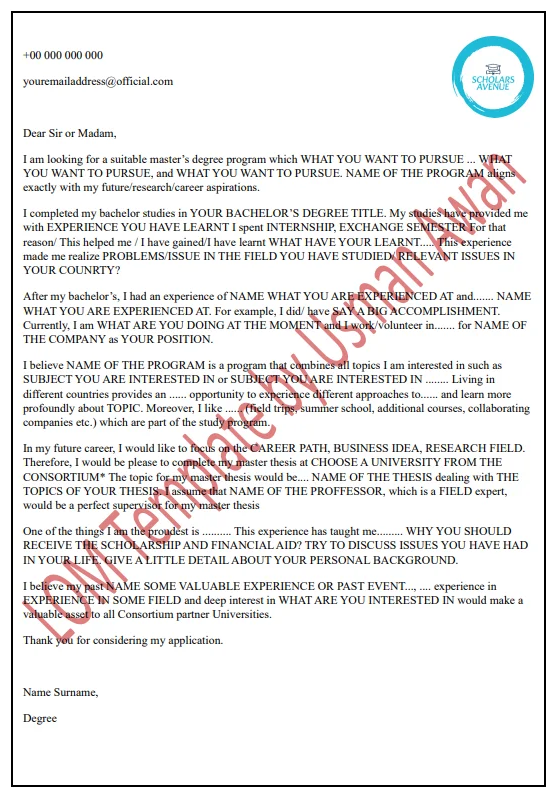
Final Tips
Before submitting your motivation letter, revise it carefully. Ensure clarity, consistency, and logical flow. Ask a trusted mentor or advisor to review it if possible. An original, well-structured, and thoughtful motivation letter will always stand out.
Remember: there is no universal template. Your letter should reflect your journey, your goals, and your voice.
Good luck with your scholarship applications, and may your academic ambitions turn into reality.
You can check a detailed video on Letter of Motivation here:
Frequently Asked Questions
What is a letter of motivation for a scholarship?
A letter of motivation is a formal document in which an applicant explains their academic background, career goals, and reasons for applying for a specific scholarship. It helps the selection committee understand the applicant’s motivation, suitability, and potential impact beyond grades and certificates.
How long should a scholarship motivation letter be?
Most scholarship providers expect a motivation letter to be between 500 and 700 words, unless stated otherwise. Applicants should always follow the official word limit and focus on clarity, relevance, and quality rather than length.
Can I use the same motivation letter for multiple scholarships?
You can use a basic framework, but each motivation letter should be customized for the specific scholarship. Reusing the same letter without tailoring it to the program’s goals, values, and requirements significantly reduces your chances of selection.
What should I avoid in a motivation letter?
Common mistakes include using vague statements, copying templates, focusing only on personal benefits, ignoring word limits, and including irrelevant information. A strong motivation letter should be specific, well-structured, and aligned with the scholarship’s objectives.
Is work experience necessary for writing a strong motivation letter?
No, work experience is not mandatory. Applicants without professional experience can highlight academic projects, internships, volunteer work, research activities, or relevant extracurricular involvement that demonstrates motivation, skills, and future potential.